
This article contains affiliate links. If you buy through them, we earn a commission at no extra cost to you. See our Affiliate Disclosure.
PFAS, often called “forever chemicals,” have turned up in drinking water across the country. Birmingham is no exception. Federal monitoring in 2024 found four PFAS compounds in the water Central Alabama Water delivers, including one at 90% of the new national limit. Here is what that means, where the federal rules stand, and how to reduce your exposure at home.
Key takeaways
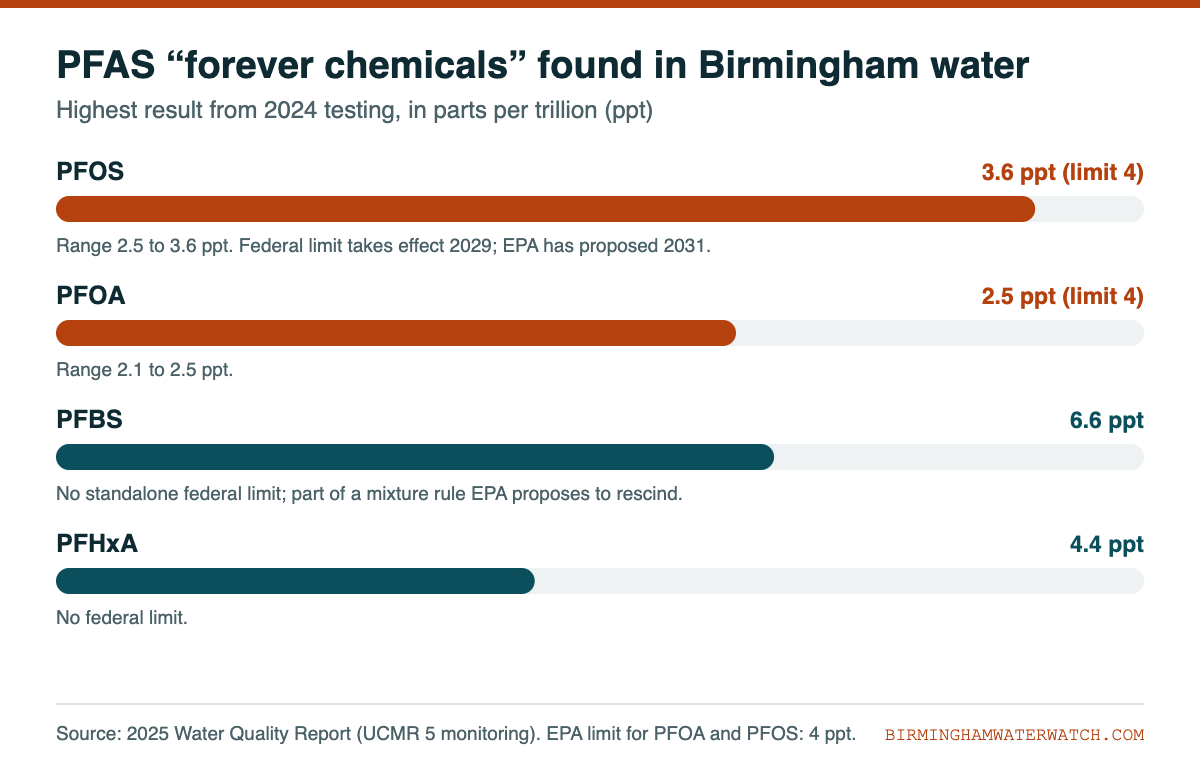
- Birmingham’s highest PFOS result was 3.6 parts per trillion; PFOA peaked at 2.5 ppt. The EPA limit for each is 4 ppt.
- Those limits do not take effect until 2029, and in May 2026 the EPA proposed delaying them to 2031.
- The EPA also proposed dropping limits on four other PFAS, including PFBS, which was found in Birmingham water.
- Under-sink filters certified for PFOA and PFOS reduction are the most practical fix at home.
What PFAS are
Per- and polyfluoroalkyl substances are a family of thousands of man-made chemicals used since the 1940s in nonstick cookware, stain- and water-resistant fabrics, food packaging and firefighting foam. Their carbon-fluorine bonds are among the strongest in chemistry, which is why they barely break down in the environment or in the human body.
The EPA links long-term exposure to certain PFAS with increased risk of some cancers, effects on the liver and immune system, higher cholesterol, and developmental effects in infants and children. That is why the EPA set its limits for PFOA and PFOS at 4 parts per trillion, about the lowest level that can be reliably measured.
What Birmingham’s testing found
Large utilities like Central Alabama Water took part in the EPA’s fifth Unregulated Contaminant Monitoring Rule (UCMR 5), which tested for 29 PFAS nationwide. Birmingham’s 2025 water quality report lists four detections:
| Chemical | Highest result | Range | Federal limit |
|---|---|---|---|
| PFOS | 3.6 ppt | 2.5 to 3.6 ppt | 4 ppt (from 2029) |
| PFOA | 2.5 ppt | 2.1 to 2.5 ppt | 4 ppt (from 2029) |
| PFBS | 6.6 ppt | 3.6 to 6.6 ppt | None on its own |
| PFHxA | 4.4 ppt | 2.9 to 4.4 ppt | None |
A part per trillion is tiny: about one drop in 20 Olympic swimming pools. But these limits were set at that level because the EPA concluded there is no level of PFOA or PFOS without some risk over a lifetime.
Compliance will eventually be judged on a running annual average, not a single high sample, so Birmingham is not out of compliance. Still, a peak of 3.6 ppt leaves little margin.
Where the federal rules stand
In April 2024, the EPA finalized the first national PFAS drinking water standard. It set 4 ppt limits for PFOA and PFOS, 10 ppt limits for PFHxS, PFNA and HFPO-DA (GenX), and a combined “hazard index” for mixtures that included PFBS. Utilities had until 2029 to comply.
On May 18, 2026, the EPA proposed two changes: keep the 4 ppt limits for PFOA and PFOS but extend the deadline to April 2031, and rescind the limits on the other four chemicals and the mixture index. The agency said the earlier rule skipped required steps and that it may regulate those chemicals again later. The public comment period closed July 20, 2026. Several states have moved to set their own limits in the meantime.
Alabama is no stranger to PFAS. Communities along the Tennessee River near Decatur have dealt with contamination from chemical manufacturing for years. Birmingham’s water comes from the Black Warrior and Cahaba river basins instead.
How to reduce PFAS at home
You cannot boil PFAS away; boiling actually concentrates them slightly. Three technologies work well:
- Activated carbon, especially in a well-designed under-sink system with enough contact time.
- Reverse osmosis, which removes the most but wastes water and needs its own faucet.
- Ion exchange, used mostly by utilities.
Whatever you buy, check the certification. Look for a filter certified to NSF/ANSI Standard 53 or 58 for PFOA and PFOS reduction (sometimes listed as protocol P473). Many pitchers are certified only for taste and chlorine.

Aquasana Claryum 2-Stage Under-Sink
Certified by WQA to NSF/ANSI 53 including PFOA/PFOS reduction, plus lead and chlorine byproducts. One system covers the three issues that matter most in Birmingham water.
Check today’s price at AquasanaA whole house system treats water for showers and laundry too, but for PFAS the priority is the water you drink and cook with. The CDC’s Agency for Toxic Substances and Disease Registry says bathing and showering are not considered a major route of PFAS exposure.
What we will watch
Utilities must begin regular PFAS monitoring under the federal rule, and the EPA expects to finalize its May 2026 proposals later. We will update this article and the Birmingham Water Report when Central Alabama Water publishes new results.
Sources
- Birmingham Water Works 2025 Water Quality Report (UCMR 5 results)
- Ballard Spahr: EPA rolls back PFAS regulations, states fill the gap (June 2026)
- Jones Day: EPA proposes to rescind certain PFAS standards (May 2026)
- Harvard Environmental & Energy Law Program: PFAS in drinking water tracker
This article is general information, not medical advice.