
In March 2026, Birmingham-area residents learned their water would no longer contain added fluoride. Then they learned most of it had not contained added fluoride for years. Here is what happened, what it means for your family’s teeth, and the simple steps dentists recommend now.
Key takeaways
- Three of Central Alabama Water’s four treatment plants stopped adding fluoride between 2023 and March 2024 because of failing equipment. The public was not told.
- In March 2026 the utility moved to end fluoridation at the fourth plant, Shades Mountain, too.
- A judge briefly ordered fluoride restored, then dismissed the City of Birmingham’s lawsuit on April 20, 2026.
- Natural fluoride in the region is below the level health officials recommend for preventing cavities.
- Children are most affected. Talk to your dentist or pediatrician about fluoride toothpaste, varnish and supplements.
What happened
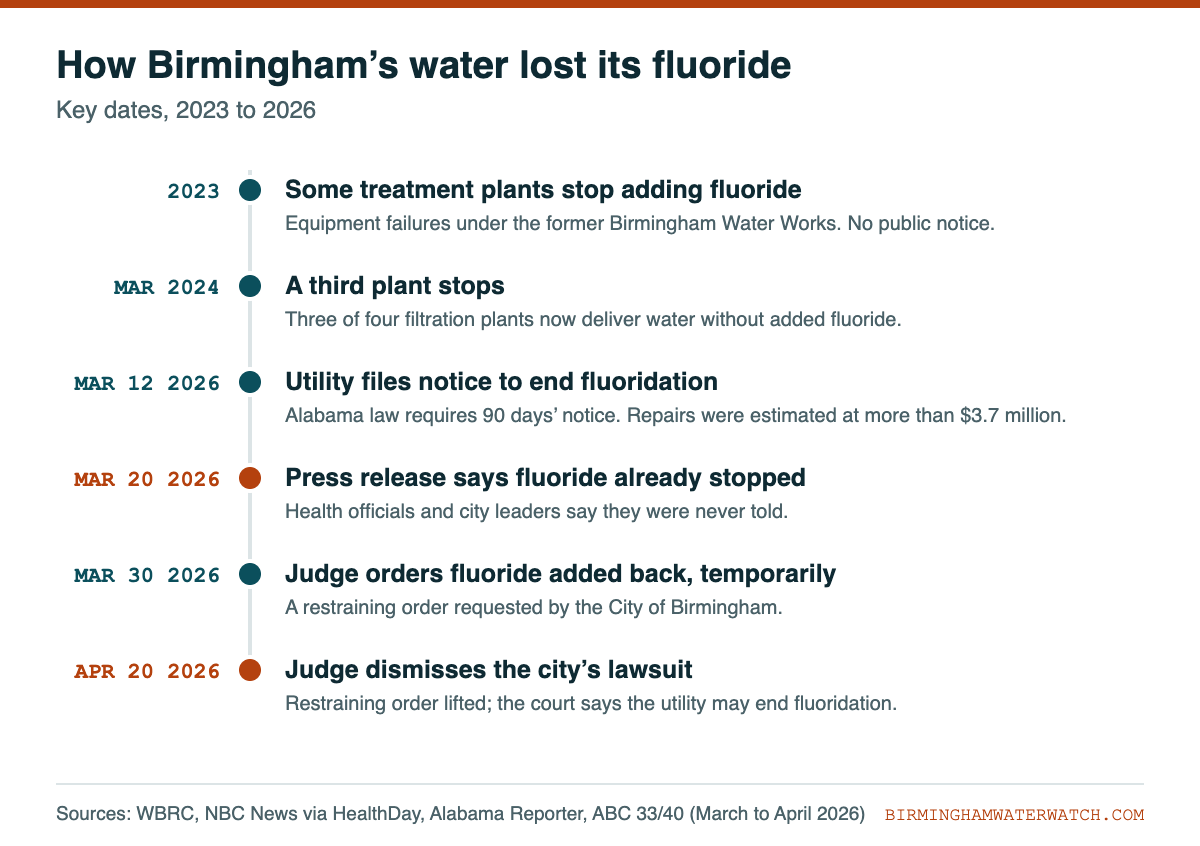
Health officials had assumed Birmingham’s water had been fluoridated since 1982. In fact, according to the utility, some plants stopped adding fluoride as early as 2023 and a third plant stopped in March 2024, largely because the fluoride equipment failed under the former Birmingham Water Works. A utility spokesperson said there is “no record” that customers were told.
On March 12, 2026, the renamed Central Alabama Water filed formal notice that it intended to end fluoridation, citing aging equipment and cost. Repairs were estimated at more than $3.7 million. The utility said continuing at the one remaining plant while the others went without would be unfair to customers.
A March 20 press release said fluoridation had already stopped. Because Alabama law requires 90 days’ notice to the state health officer, the City of Birmingham sued. On March 30, Jefferson County Judge Fred Bolling ordered the utility to resume adding fluoride while the case proceeded.
On April 20, the judge dismissed the city’s case. He found the utility had violated the law with its premature announcement, calling the press release “clumsy,” but had otherwise followed the required process. He also accepted evidence that fluoridation equipment at most plants had been out of service for years and could not safely be restarted right away. The restraining order was lifted.
How much fluoride is in the water now?
The utility’s most recent water quality report, covering 2024, lists a highest fluoride level of 0.65 milligrams per liter and a range from not detected to 0.65. For comparison, the U.S. Public Health Service recommends 0.7 mg/L for community water fluoridation. With most plants not adding fluoride, many homes are now getting only the small amount that occurs naturally.
Dr. David Hicks, the Jefferson County health officer, told WBRC that natural fluoride levels in central Alabama are not enough to prevent tooth decay on their own.
Why it matters, and who is most affected
Community water fluoridation has been endorsed for decades by the American Dental Association as a way to reduce cavities, especially in children. About 72% of Americans on public water systems receive fluoridated water, according to the CDC.
Fluoridation has become a national political debate. Utah and Florida have banned it, and at least 21 states have introduced similar bills. Robert F. Kennedy Jr. has argued it is harmful. Scientists quoted in national coverage say the evidence does not support claims linking fluoride at recommended levels to bone cancer or lower IQ, though research on higher exposures continues.
Local health leaders, including Dr. Hicks and state Rep. Patrick Sellers, warned that losing fluoride could hit lower-income families and people without regular dental care hardest. Dr. Scott Tomar of the University of Illinois Chicago College of Dentistry told NBC News that ending fluoridation could increase cavities, especially in young children.
What Birmingham families can do
- Brush twice a day with fluoride toothpaste. This is the single most effective step. Use a rice-grain-sized smear for children under 3 and a pea-sized amount for ages 3 to 6.
- Ask your dentist about fluoride varnish, a quick treatment painted on teeth at checkups. Many pediatricians offer it too.
- Ask your child’s pediatrician or dentist whether fluoride supplements make sense now that your water is not fluoridated. Do not start them on your own.
- Keep up with regular checkups, and ask about sealants for children’s back teeth.
- If you use bottled water, know that most brands contain little fluoride unless the label says otherwise.
Do water filters remove fluoride? Most carbon-based filters, including the under-sink and countertop systems we review, are not designed to remove fluoride. Reverse osmosis systems do remove most of it. With Birmingham’s water now low in fluoride, a carbon filter will not meaningfully change how much your family gets. Our filter picks focus on lead, PFAS and chlorine byproducts.
What happens next
The court’s ruling leaves the decision with the utility’s board. Fluoridation could return only if the board votes to repair the equipment and restart it, or if state law changes. We will update this article if that changes. For a full picture of Birmingham’s water, see the Birmingham Water Report.
Sources
- WBRC: Health leaders raise concerns after learning water lacked fluoride for years (March 25, 2026)
- HealthDay, from NBC News: Fluoride quietly removed from Birmingham water years ago (March 30, 2026)
- Alabama Reporter: Judge orders Central Alabama Water to add fluoride (March 31, 2026)
- ABC 33/40: Judge dismisses Birmingham lawsuit (April 20, 2026)
- Birmingham Water Works 2025 Water Quality Report
This article is general information, not medical or dental advice. Ask your dentist or pediatrician what is right for your family.