
This article contains affiliate links. If you buy through them, we earn a commission at no extra cost to you. See our Affiliate Disclosure.
Birmingham’s water utility treats water to a high standard, then loses a staggering share of it on the way to your house. In 2025 a consultant told the utility’s new board that about 40% of treated water leaks out of aging pipes. Since then the utility has been taken over by the state, renamed, and hit with deep budget cuts. Here is what is going on and what it means for the water at your tap.
Key takeaways
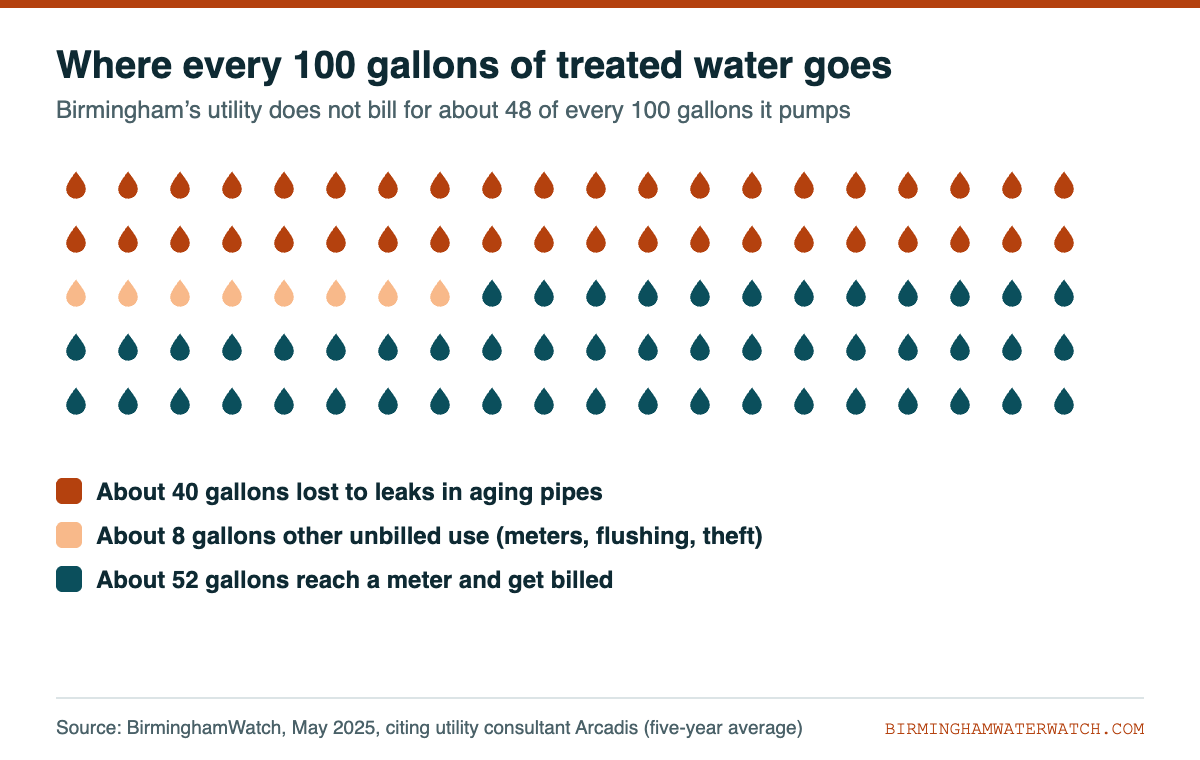
- About 40% of treated water is lost to leaks; nearly half goes unbilled once meters, flushing and theft are counted.
- A 2025 state law shifted control of the board from the City of Birmingham to state and suburban appointees, and the utility became Central Alabama Water.
- In March 2026 the board cut 225 jobs and slashed capital spending to $35 million, including pipe replacement funding.
- Customers ranked the utility last in its region in J.D. Power’s 2026 study, for the third year in a row.
- Water quality has stayed within federal standards. The bigger risk is reliability: main breaks and boil-water notices.
Where the water goes
In May 2025, consultants from Arcadis briefed the newly reconstituted board. Based on a five-year average, the utility does not get paid for 48.5% of the water it pumps. Leaks account for about 40 points of that, roughly double the utility’s own target. Nationally, utilities typically lose 20% to 30%, which put Birmingham in the worst quartile.
The cause is old pipe. Unlined cast iron and galvanized mains make up just 14.1% of the system but produce 67% of leaks. Some pipes are more than 100 years old. The utility had sped up replacement from 3 to 5 miles a year to 15 to 17 miles, but about 584 miles of problem pipe remained, roughly 40 years of work at that pace, at about $1.5 million per mile. The utility also carries about $1 billion in debt.
Every gallon that leaks was already pumped, treated and disinfected. Customers pay for that through their rates.
The takeover
In May 2025, Gov. Kay Ivey signed a law restructuring the Birmingham Water Works Board. The board shrank from nine members to seven, and appointment power moved from Birmingham city officials to the governor, the lieutenant governor and the four surrounding counties. Supporters cited frequent rate hikes, aging infrastructure and past scandals, and pointed to crises in Jackson, Mississippi, and Detroit.
Mayor Randall Woodfin and the city council filed a federal lawsuit, arguing the law gives majority-white suburbs outsized control over a system where close to half of customers live in majority-Black Birmingham. A federal judge declined to block the law while the case proceeded. The utility now operates as Central Alabama Water.
The 2026 budget cuts
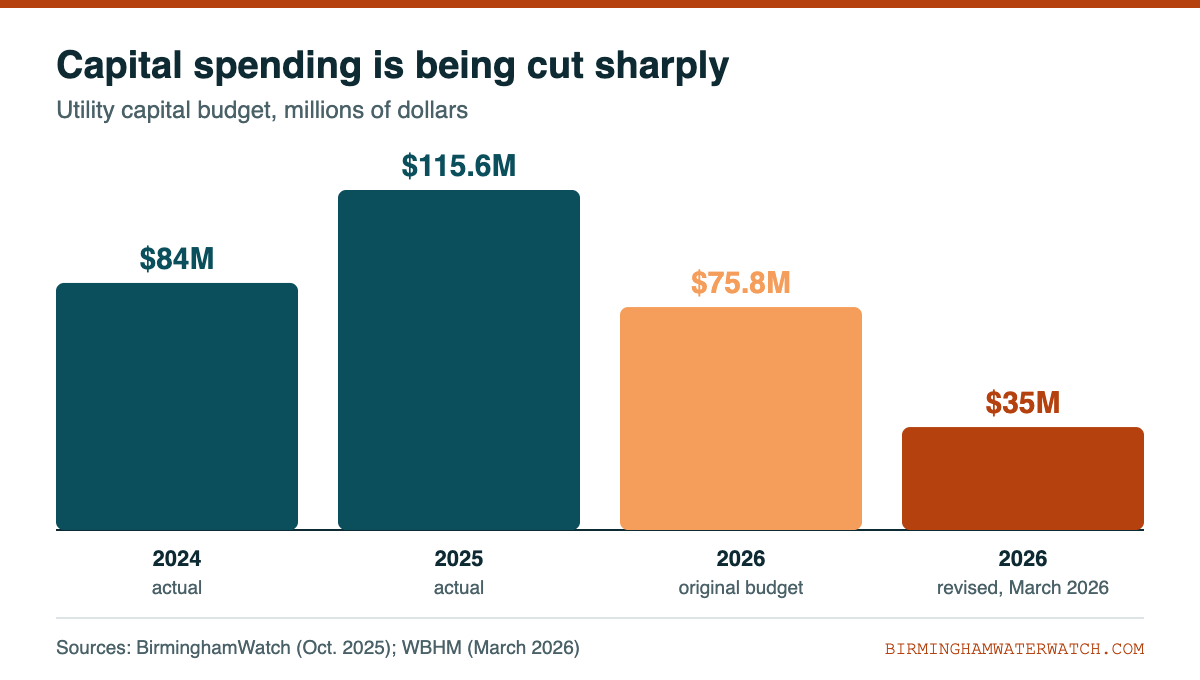
The utility spent $115.6 million on capital projects in 2025. In March 2026, the board revised its 2026 budget:
- Capital spending fell 54%, from $75.8 million to $35 million.
- Main pipeline replacement funding dropped from $15 million to $2.1 million. A $500,000 leak survey was added.
- Lake Purdy Dam stabilization was cut from $22 million to $7.7 million, effectively ending the larger rehabilitation of the 116-year-old dam in favor of short-term safety measures.
- Total spending fell 25%, including 225 positions cut from a workforce of 688. The utility had laid off 135 employees the week before.
The board also voted 4-2-1 to give CEO Jeffrey Thompson broad authority to set policy and make personnel and contracting decisions without board approval. One area that was not cut: lead service line replacement, which is funded by about $56 million in low-interest state loans approved in April 2026.
How customers feel
In J.D. Power’s 2026 U.S. Water Utility Residential Customer Satisfaction Study, Central Alabama Water scored 416 out of 1,000, up slightly from 413. That was last in the South-Midsize group for the third straight year, 103 points below the group average, and second-lowest nationally among 92 large systems. Only Baltimore ranked lower.
What it means at your tap
The good news is that the utility’s most recent water quality report showed no health-based violations, and the utility told its board in 2025 that it had gone 44 years without an EPA water quality violation. Here is what the latest testing shows.
The bigger risk from aging pipes and smaller budgets is reliability. In May 2024, a large main break at the Western filter plant left more than 10,000 people in northwest Jefferson County with outages or low pressure, closed eight schools and triggered a boil-water notice that lasted four days. Fewer dollars for pipe replacement means more of these events are possible.
During a boil-water notice, a home water filter is not a substitute for boiling. The filters we review are designed for chemicals like lead, chlorine byproducts and PFAS, not for disinfecting water that may contain bacteria. Follow the notice, bring water to a rolling boil for at least three minutes, or use bottled water until the all-clear.
What you can do
- Keep an emergency supply of at least one gallon per person per day for three days.
- Follow Central Alabama Water and local TV stations for boil-water notices in your area.
- Check your own service line. Older systems mean older connections. Here is how.
- Filter for everyday quality. Disturbances from main breaks and repairs can loosen sediment and, in older homes, lead. A certified filter handles the day-to-day.

Aquasana Claryum 2-Stage Under-Sink
Filtered water at your kitchen tap. Certified for lead and PFOA/PFOS reduction.

Aquasana Rhino Whole House
Filters every faucet and shower at the main line. Rated for 10 years or 1,000,000 gallons.
Sources
- BirminghamWatch: 40% of water lost to leaks, new board learns (May 2025)
- WBHM / AP: Ivey overhauls Birmingham Water Works Board (2025)
- BirminghamWatch: Capital cuts loom (October 2025)
- WBHM: Board cuts budget and dam rehab, expands CEO’s power (March 2026)
- WBRC: Central Alabama Water ranks last in customer satisfaction survey (May 2026)
- WVTM 13: Water main break closes schools (May 2024)
- ABC 33/40: Boil water alert lifted (May 2024)