
This article contains affiliate links. If you buy through them, we earn a commission at no extra cost to you. See our Affiliate Disclosure.
Short answer: yes, Birmingham tap water meets every federal drinking water standard currently in force. But “meets the standard” and “nothing to think about” are not the same thing. The latest annual water quality report from Central Alabama Water shows a few numbers worth knowing, especially if you live in an older home, have young children, or are pregnant.
Here is what the report says, in plain English, and what we would do about it.
Key takeaways
- No health-based violations in the most recent report, which covers 2024 testing.
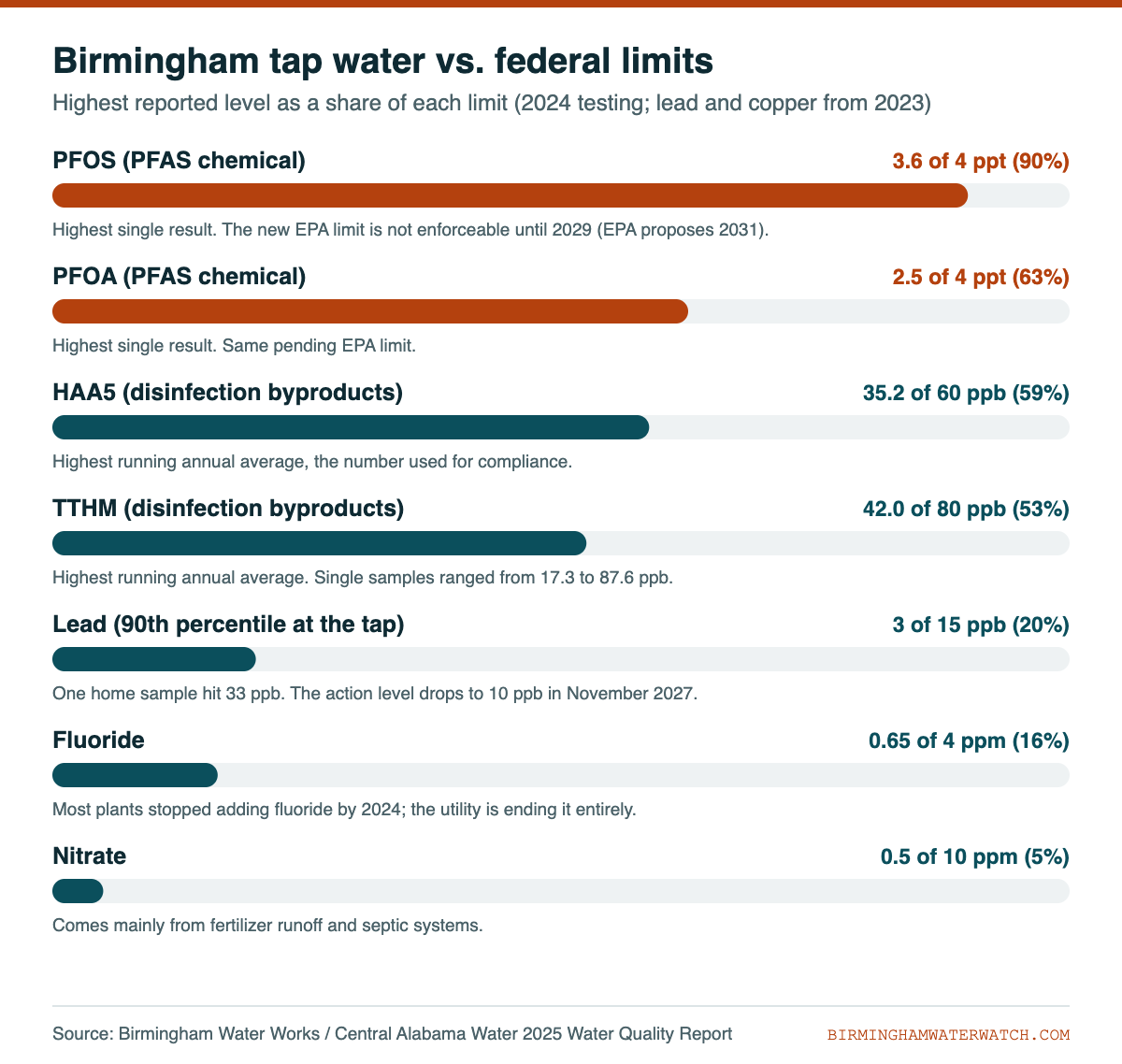
- PFOS, a PFAS “forever chemical,” peaked at 3.6 parts per trillion. The new federal limit, effective 2029, is 4.
- Disinfection byproducts averaged about half the legal limit, but one sample reached 87.6 ppb against an 80 ppb limit.
- Lead is low system-wide, but one home sample hit 33 ppb, more than twice the action level.
- A certified under-sink filter handles all of the above for about the cost of a few months of bottled water.
Where the numbers come from
Every U.S. water utility must publish a Consumer Confidence Report each year. Birmingham’s most recent report was released in 2025 under the Birmingham Water Works name and covers testing from January through December 2024. Lead and copper are tested every few years; the results in this report come from June through September 2023. The next round of lead sampling ran from June through September 2026.
The utility, now called Central Alabama Water, serves about 770,000 people. It draws from the Black Warrior and Cahaba river basins and treats water at four plants: Putnam, Western, Carson and Shades Mountain.
The good news
Several things in the report are reassuring:
- No E. coli. Total coliform bacteria, a general indicator, turned up in just 3 of 405 monthly samples, well within the rules.
- Nitrate is low. The highest reading was 0.5 parts per million against a limit of 10.
- Copper is low. The 90th percentile reading was 0.10 ppm against an action level of 1.3.
- Turbidity, a measure of cloudiness, was well controlled, peaking at 0.19 against a 0.3 treatment standard.
- Radioactive elements like radium were at trace levels.
Three numbers worth a closer look
1. PFAS: close to the new limit
PFAS are a family of man-made chemicals used in nonstick, stain-resistant and firefighting products. They break down extremely slowly. In 2024 the EPA set the first enforceable limits for two of them, PFOA and PFOS, at 4 parts per trillion each. Birmingham’s highest PFOS result was 3.6 ppt, and PFOA reached 2.5 ppt.
Those limits do not take effect until 2029, and in May 2026 the EPA proposed pushing the deadline to 2031. So Birmingham is not in violation of anything. But 3.6 is 90% of a limit the EPA set based on long-term health risk. Our PFAS explainer goes deeper.
2. Disinfection byproducts: average is fine, peaks are not
Chlorine keeps tap water free of germs. When it reacts with natural organic matter from rivers and lakes, it forms byproducts called trihalomethanes (TTHM) and haloacetic acids (HAA5). Long-term exposure above the limits is linked to increased cancer risk.
Compliance is judged on a running annual average at each sampling site. Birmingham’s highest average was 42.0 ppb for TTHM (limit 80) and 35.2 ppb for HAA5 (limit 60). But individual TTHM samples ranged as high as 87.6 ppb. Levels tend to run higher at the far ends of the system and in warm months, when water sits longer in pipes.
3. Lead: low overall, high in at least one home
Lead is measured at home taps, because it comes from service lines and plumbing, not from treatment plants. The 90th percentile result was 3 ppb, far below the 15 ppb action level. But results ranged up to 33 ppb, and one sample exceeded the action level.
That is the pattern you would expect in a system with mostly safe pipes and some lead ones. With about 39,000 service lines still of unknown material, the system-wide average does not tell you what is coming out of your faucet. There is no known safe level of lead exposure, especially for children.
What about fluoride and hardness?
Fluoride peaked at 0.65 ppm in 2024. Most treatment plants had already stopped adding it because of broken equipment, and the utility is now ending fluoridation entirely. Here is what that means for your family’s teeth.
Hardness ranged from 40 to 156 mg/L depending on which plant serves you. That runs from soft to hard. Hard water is not a health concern, but it leaves spots and scale.
So should you filter?
You do not need to buy bottled water. But a good filter is a cheap, sensible upgrade in Birmingham, for three reasons: it reduces lead at the tap regardless of what pipe serves your house, it cuts chlorine byproducts, and it gets ahead of PFAS before the federal limits kick in.
Look for certification to NSF/ANSI Standard 53 (lead and other health contaminants) and NSF/ANSI 53 with P473 or Standard 58 for PFOA and PFOS. A basic pitcher certified only to Standard 42 improves taste but does not address lead.

Aquasana Claryum 2-Stage Under-Sink
Certified by WQA to NSF/ANSI Standards 42, 53 (including PFOA/PFOS) and 401. It filters your drinking and cooking water at full pressure through your existing kitchen faucet.
Check today’s price at AquasanaRenting? The Clean Water Machine sits on the counter with no plumbing. Want every tap covered? See the Rhino whole house system.
Frequently asked questions
Is it safe to drink Birmingham tap water without a filter?
For most healthy adults, yes. The water meets all current federal standards. If your home was built before 1989, your service line is unknown, or you are mixing baby formula, use a lead-certified filter or have your water tested.
How do I get my water tested?
Call Central Alabama Water’s water quality team at (205) 244-4375 to request a lead test.
Does boiling water make it safer?
Boiling kills germs, which is why it is used during boil-water notices. It does not remove lead or PFAS, and it can slightly concentrate them as water evaporates.
Sources
- Birmingham Water Works 2025 Water Quality Report (2024 data)
- BirminghamWatch: Is there lead in your water? (July 2025)
- Ballard Spahr: EPA rolls back PFAS regulations (June 2026)
- The Birmingham Water Report
This article is general information, not medical advice. Talk to your doctor about specific health concerns.