
This article contains affiliate links. If you buy through them, we earn a commission at no extra cost to you. See our Affiliate Disclosure.
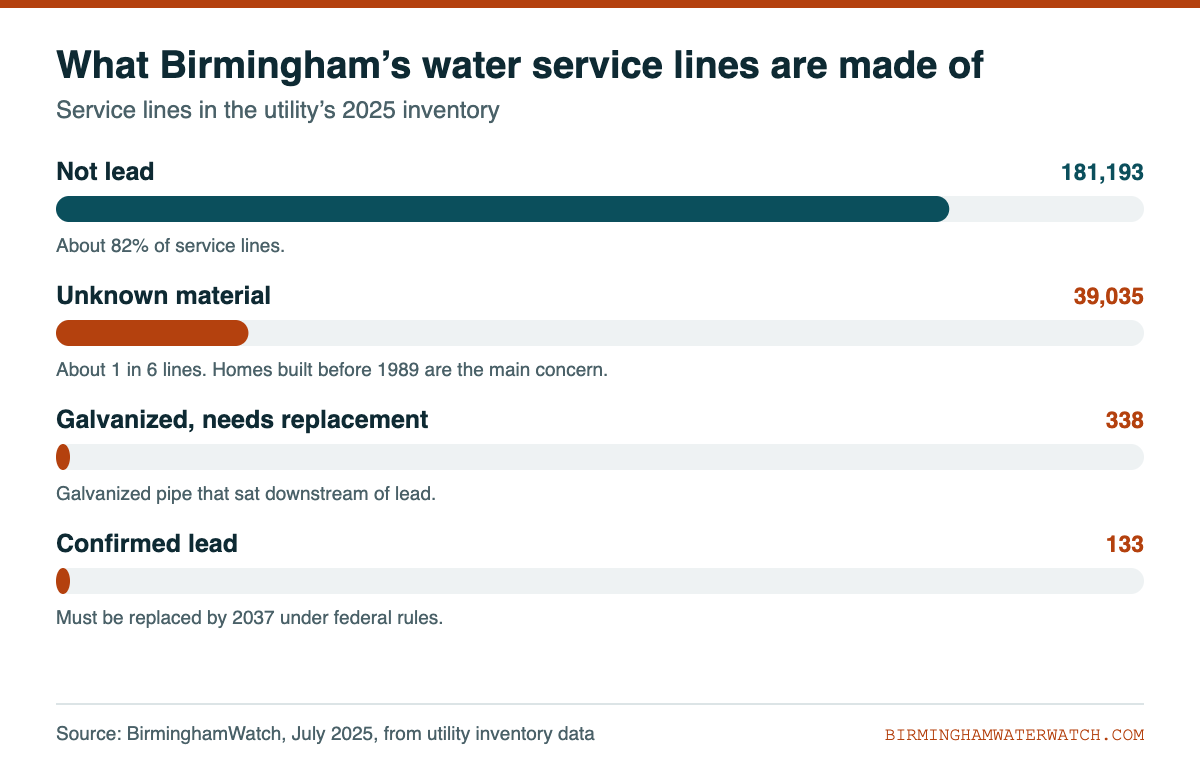
Central Alabama Water’s inventory lists about 39,000 water service lines whose material is simply unknown. If your house is one of them, nobody can tell you for certain whether lead is touching your drinking water. The good news: you can usually find out yourself in about 15 minutes, with a key and a refrigerator magnet.
Key takeaways
- Of roughly 220,000 service lines, 133 are confirmed lead, 338 are galvanized lines that need replacing and 39,035 are unknown.
- Homes and buildings built before 1989 are the main concern.
- Look up your address in the utility’s online map, then check the pipe where it enters your home.
- Free lead testing: call Central Alabama Water at (205) 244-4375.
- Every lead line must be replaced by 2037. Until yours is, filter what you drink.
Why the service line matters most
The service line is the pipe that runs from the water main under the street to your house. When it is made of lead, it is usually the single largest source of lead in a home’s drinking water. The EPA and medical researchers agree there is no safe level of lead exposure. Children are most at risk because lead affects brain development.
Birmingham’s treatment plants add corrosion control that helps keep lead from leaching out of old pipes, and system-wide test results are low. But one 2023 home sample still came in at 33 parts per billion, more than double the federal action level. Averages do not protect any one house.
Step 1: Look up your address
Central Alabama Water publishes a service line lookup map. Type in your address to see how the utility currently classifies your line: lead, galvanized requiring replacement, non-lead, or unknown.
If it says non-lead, you can stop here, though if your house is older it is still worth checking your side of the line. If it says unknown, keep going.
Step 2: Find the pipe where it enters your home
Your service line usually comes through the foundation and ends at the main shutoff valve. In Birmingham-area homes that is most often in a basement or crawl space, sometimes in a utility closet or near the water heater. Look at the few inches of pipe just before the valve.
Step 3: Scratch and magnet test
- Look at the color. Copper is the color of a penny. Plastic is white, black or blue. Gray pipe may be lead or galvanized steel.
- Gently scratch it with a key or the edge of a coin. Lead is soft and reveals a shiny silver color. Copper shows a bright penny color.
- Try a magnet. A strong magnet sticks to galvanized steel. It does not stick to lead or copper.
Soft, silver when scratched and not magnetic: likely lead. Hard to scratch and magnetic: likely galvanized. Take a photo either way.
One spot is not proof. The EPA recommends checking at two points when records are missing, and a plumber can confirm. Do not cut, sand or file the pipe.
Step 4: Report it and get tested
Tell the utility what you found; its inventory page links to a customer survey. Then call Central Alabama Water’s water quality team at (205) 244-4375 to request a test. Note that a clean test does not prove you do not have a lead line, because corrosion control can keep levels low most of the time.
What happens if you have a lead line?
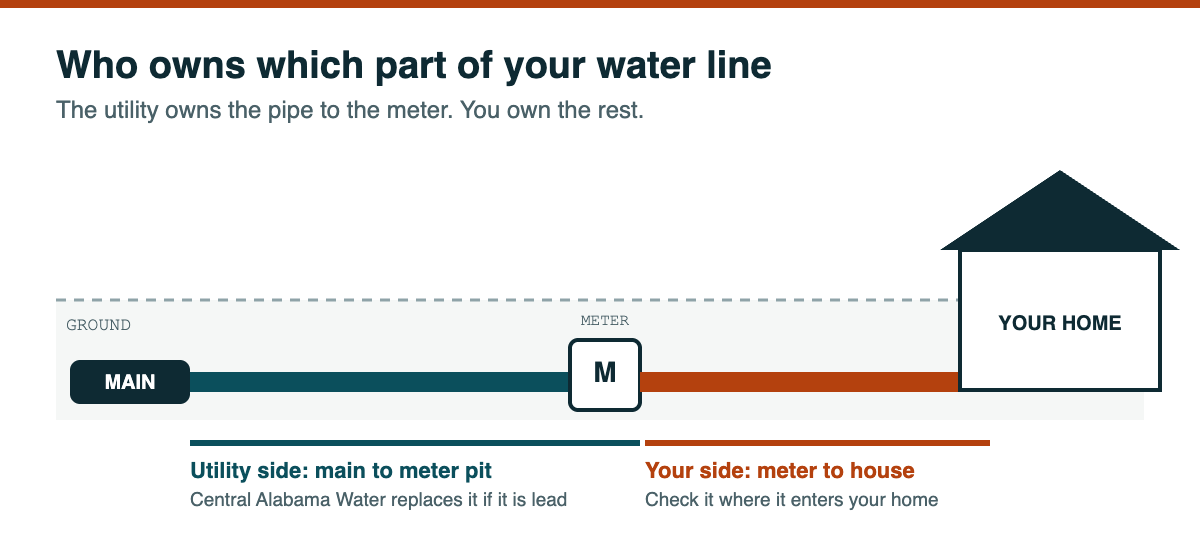
Central Alabama Water owns the line from the main to the meter pit and will replace that section if it is lead, or galvanized pipe connected to a lead gooseneck. You own the rest, from the meter to your house. The utility has said it will ask property owners to sign a waiver so contractors can work on private property.
In April 2026, the utility’s board approved two state revolving fund loans totaling $56.4 million for lead line replacement, including $13.8 million in principal forgiveness. The state has set aside up to $292.6 million in federal funds for the work. A former utility manager estimated the cost at about $8,000 per line.
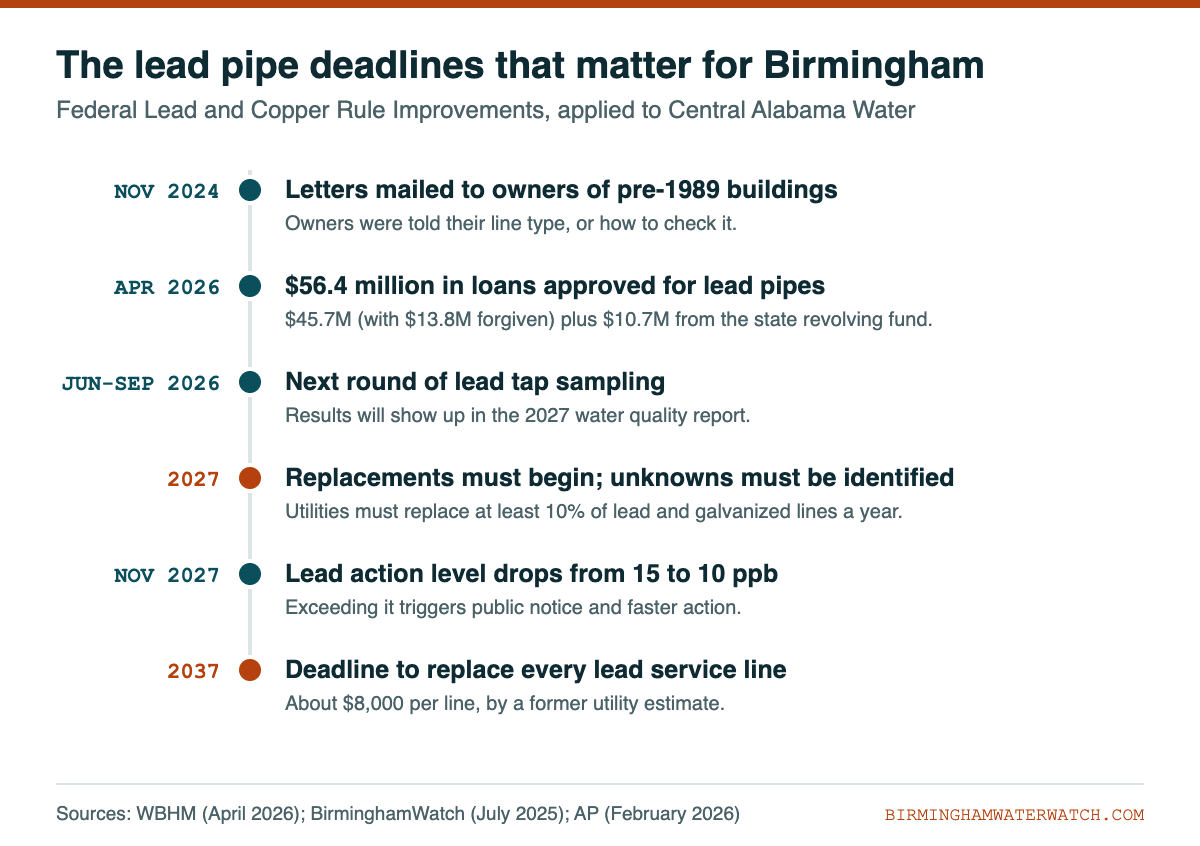
Under federal rules, utilities must start replacing lead lines in 2027 and finish by 2037. In February 2026, the EPA said it will defend that 10-year deadline in court against a challenge from the water utility industry. Starting November 2027, the lead action level also drops from 15 to 10 parts per billion.
What to do while you wait
- Filter your drinking and cooking water with a filter certified to NSF/ANSI Standard 53 for lead.
- Run the cold tap for several minutes if water has sat for more than six hours, such as first thing in the morning.
- Use only cold water for drinking, cooking and baby formula. Hot water draws more lead from pipes.
- Clean faucet aerators every few months; they can trap lead particles.
- Be extra careful during nearby construction. Work on mains or partial line replacements can temporarily shake loose lead.

Aquasana Claryum 2-Stage Under-Sink
Certified to NSF/ANSI Standard 53, which covers lead reduction, plus PFOA and PFOS. It installs under the sink and filters water through your existing cold tap.
Check today’s price at AquasanaRenting and cannot touch the plumbing? The Clean Water Machine is a countertop option.
Sources
- Central Alabama Water: Lead service line FAQs
- BirminghamWatch: Is there lead in your water? (July 2025)
- WBHM: Utility secures loans to replace lead pipelines (April 2026)
- AP via The Intelligencer: EPA backs mandate to replace lead pipes (February 2026)
- U.S. EPA: Lead and Copper Rule Improvements
This article is general information, not medical advice. If you are worried about lead exposure, ask your doctor about a blood lead test.